Part 1 — Interview
Answer → Reason → Extension
Builds a complete, natural 3-move answer to any Part 1 question in about 45 seconds — a direct answer, a supporting reason, and one extension that shows range.
Examiner-Reviewed · Anti-Template · Built for Chinese Learners
Most candidates who plateau at 6.5 don't lack English — they lack a way to build an answer under pressure. Deen Cox's five-book system replaces memorised templates with 14 generative frameworks, each reviewed against the official Band Descriptors by former IELTS examiner Mike Wattie.
As a published IELTS author, I particularly value the freshness of this book's approach and the way it translates the demands of the test into practical steps students can actually use.
Mike Wattie — Former IELTS Examiner & Published IELTS Author
About 关于作者
Certified IELTS Specialist · Author · Curriculum Developer · Beijing, China
Deen Cox has spent nearly two decades in the same conversation with students: "I've studied for months. Why am I still stuck at 6.5?"
The answer is almost never vocabulary or grammar. It's structure. Candidates who plateau rarely lack English ability — they lack a repeatable way to build an answer under exam pressure. And the Chinese test-preparation market's dominant response to that problem — memorised template answers (模板背诵) — is the very thing modern examiners are trained to detect and penalise.
His method was forged in live, exam-style conditions: ten years of mock interviews, recorded and dissected candidate answers, and measurement against the official band descriptors. Along the way he catalogued the exact patterns examiners penalise — from L1-transfer grammar errors and flat sentence stress to circular logic and memorised phrasing. The 14 frameworks across his five books are the distilled result of that decade of close observation.
He has also co-authored IELTS study guides across all four skills — Listening, Reading, Writing, and Speaking — with Mike Wattie, a former IELTS Examiner, whose review anchors every framework in this system to how each paper is actually assessed.
Every framework was tested with real students and only written down once it reliably worked.
Reviewed line by line against the official Band Descriptors — not test-taker folklore.
Built around the L1-transfer errors Mandarin and Cantonese speakers actually make.
The Method 方法论
One idea organises all five books — and it's important enough that the Speaking Guide devotes an entire chapter to it: Chapter 8, "The Anti-Template Manifesto."
Pre-written answers collapse the moment a question is rephrased, flatten delivery into a recognisable recital rhythm, and are treated by examiners as a band ceiling, not a band floor. Examiner training specifically covers spotting memorisation.
Generative frameworks reshape to fit any prompt and produce speech and writing that is authentically yours — natural, flexible, and precise. That is exactly what the Band 7+ descriptors reward.
Answer → Reason → Extension
Builds a complete, natural 3-move answer to any Part 1 question in about 45 seconds — a direct answer, a supporting reason, and one extension that shows range.
Past → Present → Future → Emotion / Elaborate
Turns any cue card into a two-minute narrative with built-in tense variety — the grammatical range examiners listen for — and a personal close that sounds unscripted.
Find the core → Elaborate → Evidence → Link
Handles abstract discussion questions with the "point first, then support" argument shape English academic discourse expects — the exact opposite of the circular wind-up that costs coherence marks.
Select → Categorise → Order → Report → Extend
Five mental steps that turn any chart, table, map, or process into a Band 7+ report without hesitation.
Overview → Pattern → Approximation → Lexis
Guarantees the "clear overview" that Task Achievement requires — the single paragraph whose absence caps a Task 1 score.
Question type → Signals → Constraints → Angle → Next step
Identifies the essay type in 30 seconds so the right structure deploys automatically.
5 type-specific skeletons
Opinion, Discussion, Advantages/Disadvantages, Cause–Solution and Two-Part essays each get a fixed shape — paragraph count, position placement, development logic — before a word is written.
Point → Explain → Evidence → Connect
Forces one fully developed idea per paragraph — the structural difference between Band 6 "listing" and Band 7 "developing."
4 cohesion types
Goes beyond "use linking words" — referencing, substitution, logical connectors, and paragraph-level signposting, used sparingly and precisely as Band 7 coherence demands.
Scan → Word-form check → Alternative → Produce
Systematically replaces correct-but-common words ("a big problem") with the precise, less-common items the Lexical Resource descriptor rewards ("a pressing issue").
6 structure types
Conditionals, passives, inversion, cleft sentences, relative clauses, and subordination — a controlled path to "a mix of simple and complex sentences" without an accuracy collapse.
Plan 5 → Draft 25 → Improve 5 → Mechanics 3 → Edit 2
A time-boxed exam process so the clock never owns the candidate.
Direction · Speed · Extent
Verb–noun pairs and adverb collocations organised so "increase/decrease" never repeats.
Ranking · Similarity · Proportion · Change · Grouping
A rotation system for comparative language across every Task 1 question type.
The Books 出版物
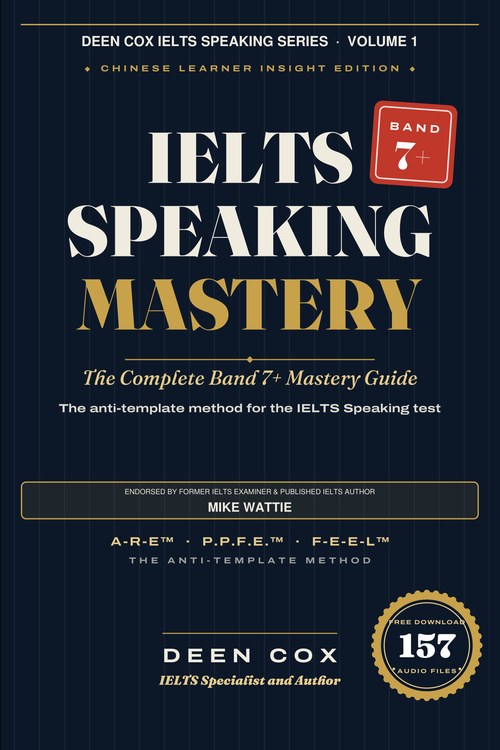
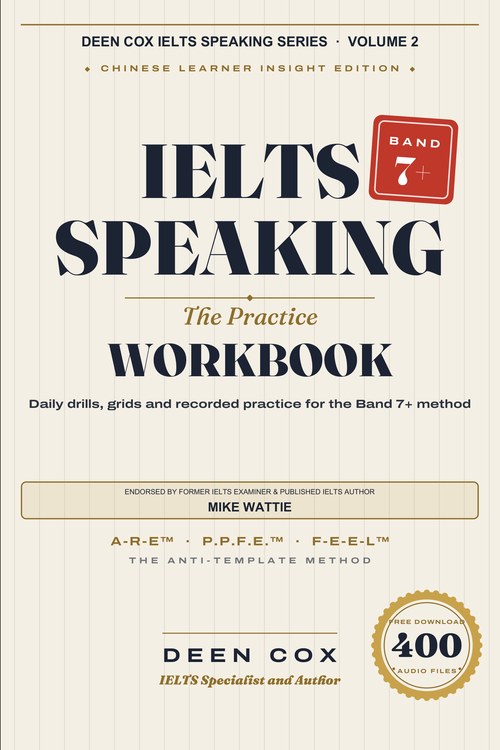
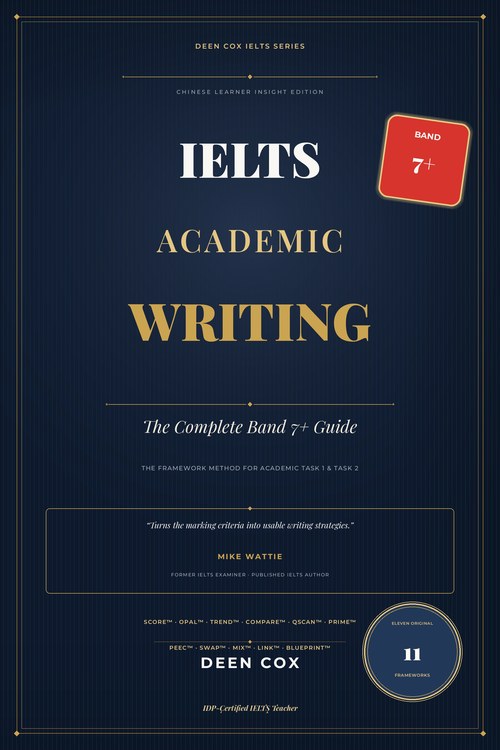
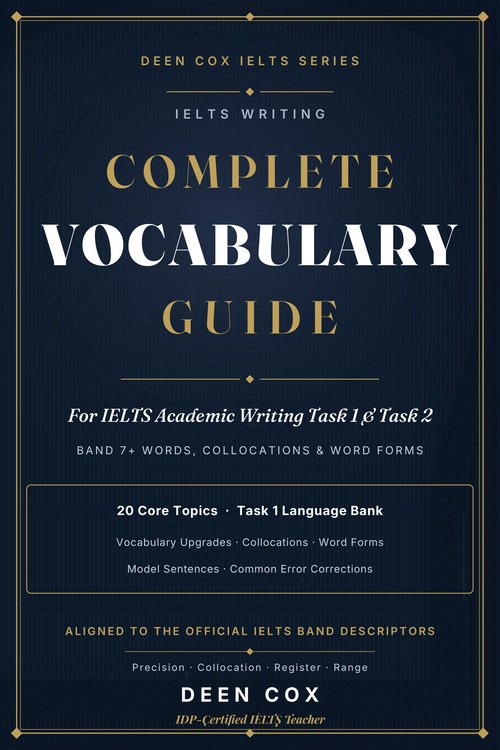
A Speaking trilogy — study, practise, teach — and two Writing titles, all anchored to the same frameworks and the official Band Descriptors, and all reviewed by former IELTS examiner Mike Wattie.
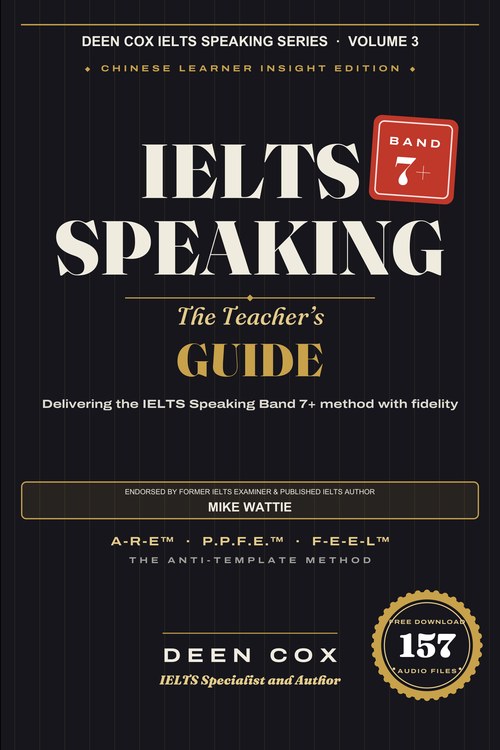
Flagship · Study Guide
Fluency · Accuracy · Range — for every part of the Speaking test
Institutional · Licensing Title
The rarest layer in this market — most methods live in one teacher's head. This one is built to scale.
Practice · Companion Volume
Zero re-taught theory. Every page is practice, cross-referenced line by line to the Guide.
Flagship · Writing
Opens with triage, not theory: the Seven Highest-Impact Fixes for Chinese-speaking candidates.
Reference · Writing
Built on one observation: Band-6 students aren't using the wrong words — they're using correct but common ones.
Inside the Books 书内一览
Real excerpts from all five titles. Notice how each one cites the others: the Teacher's Guide assigns Workbook drills, the Workbook cross-references Guide chapters, and the Vocabulary Guide feeds the Writing Guide's models.
"This book will never teach you to deceive an examiner, because rote memorisation is precisely what the modern test is engineered to detect — and because genuine skill serves you far beyond the exam room. If a technique only works by fooling the examiner, it is not in this book."
The chapter then names the three ways templates fail: they collapse under variation (one tilted question — "and how has that changed?" — and the script no longer fits), they flatten delivery into a tell-tale recital rhythm, and they are scored as a band ceiling, not a band floor — once speech is judged memorised, Fluency & Coherence is capped regardless of how impressive the borrowed phrases sound.
Objective: Students answer any Part 1 question with Answer–Reason–Extension, naturally. Materials: Guide Ch 2.2, 3; Workbook §2.2.
| Stage | Min | Activity |
|---|---|---|
| Warm-up | 5 | One-word-answer game — expose how thin undeveloped answers feel. |
| Presentation | 8 | Model A-R-E on three ordinary questions (Handbook 1.5). |
| Guided | 17 | Class builds A-R-E answers aloud; you police "new element" in the Extension. |
| Production | 20 | Rapid-fire: students hit A-R-E on cold questions, recorded in pairs. |
| Feedback | 10 | Two fixes max; flag any robotic "my reason is…" delivery. |
Homework: Workbook §2.2 — one topic, recorded and self-audited.
"Part 1 — Introduction & Interview (4–5 min) ► A-R-E™ ► Guide Ch. 3. Answer each question aloud. ⏱ 45 seconds per answer. Use a Hook → Reason → Extension. Record."
Q1: What kind of technology do you use most in your daily life? — plan your A-R-E™ in key words only, then speak; don't read. Ten complete mock tests follow this pattern — each with a Part 1 grid, a P.P.F.E.™ blueprint for the cue card, and an F-E-E-L™ grid for Part 3, all timed, recorded and self-assessed.
Before Chapter 1 even begins, the Guide triages the seven highest-impact fixes for Chinese-speaking candidates — each mapped to the criterion it protects:
| # | Fix | Criterion affected |
|---|---|---|
| 1 | Mark every verb for tense and subject agreement | Grammatical Range & Accuracy |
| 2 | Add articles (a / an / the) before singular nouns | Grammatical Range & Accuracy |
| 3 | Never pluralise uncountable nouns (research, information) | Lexical Resource / GRA |
| 4 | Break comma splices with conjunctions or semicolons | Grammatical Range & Accuracy |
| 5 | State your point first, then explain (PEEC order) | Coherence & Cohesion |
| 6 | Replace translated idioms with natural collocations | Lexical Resource |
| 7 | Commit to and defend a clear position | Task Response |
"Vocabulary is not built by reading lists — it is built by producing language."
For every entry in the book: read the model sentence and identify the collocation in context → cover the Band 7+ column and try the upgrade yourself → write your own original IELTS sentence using the same structure → use the word again in a practice essay the same day. A sample from the trend-language system:
| Direction | Verb | Register |
|---|---|---|
| Rise | surged | Strong — sudden, dramatic upward movement |
| Fall | plummeted | Strong — sudden, dramatic fall to a low level |
| Stable | plateaued | Reached a high/low point and stopped changing |
Cross-Series Feature 中国学习者洞察
Not a marketing label — a structural feature, repeated at the point of need throughout the series.
Across the series, "Chinese Learner Insight" is a specific, recurring panel: a boxed note placed exactly where a Mandarin or Cantonese speaker is statistically most likely to go wrong, naming the error pattern and giving the fix. It appears 23 times in the Speaking Guide and 8 times in the Academic Writing Guide — never as a generic aside, always tied to the surrounding chapter. These are the five error families it targets:
| Error family | Typical example | How the books fix it |
|---|---|---|
| Direct-translation "Chinglish" | "open the light" · "people mountain people sea" | Collocation taught as fixed pairs, never word-for-word substitution. |
| Articles & number | "I have many friend" | Countability and plural -s drilled together — the dropped final -s is also a pronunciation habit. |
| Tense & aspect | "Yesterday I go" | Tense anchored to time markers; relentless past-tense self-monitoring. Chinese verbs carry no tense marking, so the habit must be built deliberately. |
| Missing "be" / he-she slip | "She very tired" · "he" for "she" | High-frequency, low-stigma errors — flagged fast and drilled in pairs. |
| Linear vs. circular logic | A long wind-up before the point | "Point first, then support" — the argument shape the coherence descriptor expects, built into F-E-E-L™ and PEEC™. |
Worked Examples 实例演示
Straight from the books — one Speaking example, one Writing example.
"What kind of apps do you use the most?"
I'd like to begin by saying that I primarily rely on productivity and communication apps to manage my daily tasks.
The primary reason is that I have an incredibly hectic schedule, and these digital tools are absolutely indispensable for staying organised.
On top of that, I should add that I occasionally practise a digital detox on weekends to avoid being glued to a screen for too long.
The introduction, in 40–50 words: paraphrase → acknowledge the debate → state your position → outline the argument.
Point — one clear topic sentence per body paragraph.
Explain — unpack the point in your own logic.
Evidence — one concrete example, developed fully.
Connect — tie the paragraph back to your position. One focused idea per paragraph: the examiner rewards depth over breadth.
Marked Model Answers 范文精讲
Both taken directly from the Academic Writing Guide — complete with the criteria-alignment table, Vocabulary Spotlight and Grammar Spotlight that follow every model response in the book. The highlights show you exactly which phrases are doing the Band 7 work.
Writing Task 1 · Type 1 — Line Graph · Guide Ch. 5
The line graph shows the number of international students enrolled at two universities between 2000 and 2020. Summarise the information by selecting and reporting the main features, and make comparisons where relevant.
The Guide's briefing for this type: describe TRENDS, not individual values. Compare lines. Give figures at key points. Primary tense: past simple. Fatal error 1 — describing each data point year-by-year ('mechanical recounting', Band 5 TA). Fatal error 2 — missing the overview: TA cannot exceed Band 5 without it.
The line graph illustrates the number of international students enrolled at two universities, City University and Metro University, over a twenty-year period from 2000 to 2020.
Overall, the two universities followed contrasting trends over the period. City University experienced consistent growth in international enrolment, while Metro University's figures rose initially before declining towards the end of the period. Notably, City University had overtaken Metro University in total international students by 2020.
City University began the period with 4,200 international students in 2000. This figure grew steadily to reach 6,200 by 2008, before accelerating more sharply in the second half of the period. By 2020, enrolment had reached around 11,500, representing an increase of more than 170% over the full twenty years.
Metro University, by contrast, started the period with a considerably higher enrolment of 8,100 students — almost double that of City University at the time. Numbers rose modestly to a peak of 9,200 by 2008 but subsequently fell back to 8,600 by 2020. This decline, combined with City University's rapid expansion, meant that Metro University had lost its position as the larger institution by the end of the period.
| Introduction | TAAccurate paraphrase — no copying. LR'enrolment', 'illustrates'. GRATime frame as noun phrase. |
| Overview | TANo figures — 'contrasting trends' is an accurate general observation. GRA'before declining' — gerund clause. |
| Body 1 | TAThree data points; rate change noted ('accelerating more sharply'). LR'representing an increase of more than 170%'. |
| Body 2 | TACrossover identified — analytical, not just reading values. CC'by contrast', 'subsequently', 'combined with'. |
| Band 5/6 — avoid | Band 7+ — use instead | Why the upgrade works |
|---|---|---|
| went up a lot | grew steadily · accelerated · rose sharply | LR requires 'less common items'. Separating direction from rate shows range. |
| was bigger than | almost double that of · considerably higher than | 'Almost double' is a precise quantitative comparison — more formal and less common. |
| at the end | by the end of the period · by 2020 | Precise time markers align with the TA requirement to describe data accurately. |
| Structure | From the model response |
|---|---|
| Participial result clause | "…representing an increase of more than 170% over the full twenty years." |
| Past perfect + by [time] | "Notably, City University had overtaken Metro University in total international students by 2020." |
| Gerund sequence | "This figure grew steadily to reach 6,200 by 2008, before accelerating more sharply…" |
Writing Task 2 · Essay Type 1 — Opinion (Agree/Disagree) · Guide Ch. 18
Some people believe that university education should be free for all students. Others argue that students themselves should pay tuition fees. To what extent do you agree or disagree?
QSCAN™ analysis (from the book): Opinion essay. One question. Position required: agree or disagree. Writer takes a clear side — governments should fund tuition fees.
The question of whether university education should be publicly funded or financed by individual students has generated considerable policy debate worldwide. While there is a certain logic to the argument that graduates are the primary beneficiaries of higher education and should therefore bear its cost, I firmly believe that governments should fund university tuition, as this is the only means of ensuring equitable access to learning regardless of socioeconomic background.
The most compelling justification for free university education is that tuition fees create insurmountable financial barriers for talented individuals from lower-income families. When fees are prohibitively high, capable students may forgo university in favour of immediate employment, irrespective of their academic potential. This concern is supported by evidence from the United Kingdom, where research conducted following the introduction of £9,000 annual tuition fees documented a marked decline in applications from students in the lowest income quintile. This illustrates that fee-based systems do not simply reward academic merit — they inadvertently select for financial capacity, depriving society of a significant portion of its intellectual talent.
Furthermore, a highly educated workforce generates long-term economic returns that substantially exceed the initial public investment. University graduates typically earn higher salaries, contribute proportionally greater tax revenue, and are more likely to drive the innovation and productivity that underpin national competitiveness. From this perspective, governments that fund university education are not subsidising individual ambition — they are making a rational investment in national human capital. Countries such as Germany and Norway, which provide tuition-free higher education, consistently rank among the world's most productive and equitable economies, lending considerable empirical weight to this argument.
In conclusion, while the position that students should fund their own education is not without merit, the broader social and economic returns of universal higher education access make a compelling case for state funding. Governments that invest in tuition-free universities ultimately cultivate more innovative, productive, and equitable societies — a return that far outweighs any short-term fiscal cost.
| Introduction | TRPosition unambiguous: 'I firmly believe that governments should fund university tuition.' CCFour-sentence structure: context → acknowledgement → position → direction. GRAConcession clause. |
| Body 1 | TRIdea fully extended: claim → explanation → specific evidence → interpretive conclusion. CC'This concern is supported by' links claim to evidence; 'This illustrates' connects it back to the argument. |
| Body 2 | TRA separate, fully developed argument — not a repetition of Body 1. CC'Furthermore' used once; 'From this perspective' as a logical framing connector. GRAParallel structure. |
| Conclusion | TRNo new arguments; position restated without copying the introduction. LR'universal higher education access', 'fiscal cost' — no repetition of the body paragraphs. |
| Band 5/6 — avoid | Band 7+ — use instead | Why the upgrade works |
|---|---|---|
| a big argument for | the most compelling justification for | Precision — more formal and specific. |
| stop people from going to university | removing financial barriers preventing access to higher learning | Academic collocation + noun phrase — demonstrates LR flexibility. |
| spend money on | investing in national human capital | 'Human capital' is a precise economic term; 'investing' is more formal. |
| good for the country | cultivate more innovative, productive, and equitable societies | Specific attributes replace vague evaluation; the parallel adjective series shows GRA range. |
| shows that | illustrates that / demonstrates that / attests to | Less common, more precise academic verbs — three alternatives available. |
| Structure | From the model response |
|---|---|
| Concession clause | "While there is a certain logic to the argument that graduates are the primary beneficiaries…, I firmly believe that governments should fund university tuition." |
| Conditional | "When fees are prohibitively high, capable students may forgo university in favour of immediate employment…" |
| Relative clause | "Governments that invest in tuition-free universities ultimately cultivate more innovative, productive, and equitable societies." |
| Passive voice | "…whether university education should be publicly funded or financed by individual students…" |
| Parallel structure | "…earn higher salaries, contribute proportionally greater tax revenue, and are more likely to drive the innovation and productivity…" |
Audio Companion 免费跟读音频
The Speaking Guide and Workbook share a free audio library built for listen–shadow–record practice: the complete Pronunciation Lab, daily drills, sound-specific work (TH, consonant clusters, R/L, V/W, the schwa), Part 2 Master Story model answers, Part 3 models across ten themes, mock-test models, and a full Band 8 sample interview. Every file is named to match the exact chapter and drill it supports, and the collection is hosted on Baidu Wangpan (百度网盘) for easy access in China.
Why It's Different 差异化
Dimension by dimension — the design choices that separate this series from typical China-market IELTS material.
| Dimension | Typical China-market material | The Deen Cox IELTS system |
|---|---|---|
| Core method | Pre-written answer banks; memorise and reproduce on test day | 14 generative, trademarked frameworks that build any answer from first principles |
| Error diagnosis | General grammar and vocabulary tips, not learner-specific | Named L1-transfer error families for Mandarin/Cantonese speakers, with a fix for each |
| Examiner alignment | Written from general teaching experience or test-taker folklore | Every framework reviewed against the official Band Descriptors by a former IELTS Examiner |
| Chinese-learner content | Absent, or a direct translation of an international edition | Purpose-built "Chinese Learner Insight" editions — 31 dedicated insight panels across the series |
| Teacher support | Rare; the method usually lives in one teacher's head | A dedicated Teacher's Guide with 12 ready-to-run lessons and formal licensing terms |
| Practice volume | A thin practice section, or none at all | A 253-page Workbook with 10 full mock tests, cross-referenced line by line to the Guide |
| Audio support | None, or generic recordings sold separately | 130 free files mapped to specific chapters and drills, built for shadowing |
This table reflects the author's positioning of the series relative to the broader Chinese-market IELTS category, based on the design choices documented throughout the five titles.
Services 服务
All instruction uses the frameworks above. No generic "practise more" advice — structure first, scores follow.
For self-study learners
Five integrated books forming a complete self-study path: frameworks, model answers, practice drills, vocabulary banks, progress trackers, and 130 free audio files. Available as a set or individually.
For individual students
One-to-one diagnostics and structured coaching cycles, in Beijing or online. The focus: identify your two highest-impact fixes, build framework automaticity, then pressure-test in mock conditions.
For teachers & institutions
Licensed access to the Teacher's Guide and the full method: lesson plans, teaching notes, assessment templates, the L1-transfer toolkit, and ongoing support — for delivering the system with fidelity.
The full series is available for distribution, licensing, and institutional partnership — with a formal prospectus covering all five titles, the framework IP, the market positioning, and sample chapters. Print and EPUB editions, with buyer-watermarked digital files.
Contact 联系方式
The frameworks work — but they require your effort, your voice, and your willingness to practise aloud and record yourself. If you do the work, you will improve.
Whether you're a candidate stuck at 6.5, a teacher who wants to deliver the method, or an institution exploring partnership — the first step is the same: tell me where you are and where you need to be.